Forbes Interview: SOLUM CEO Jun Sung-ho - Technology for a Better Tomorrow
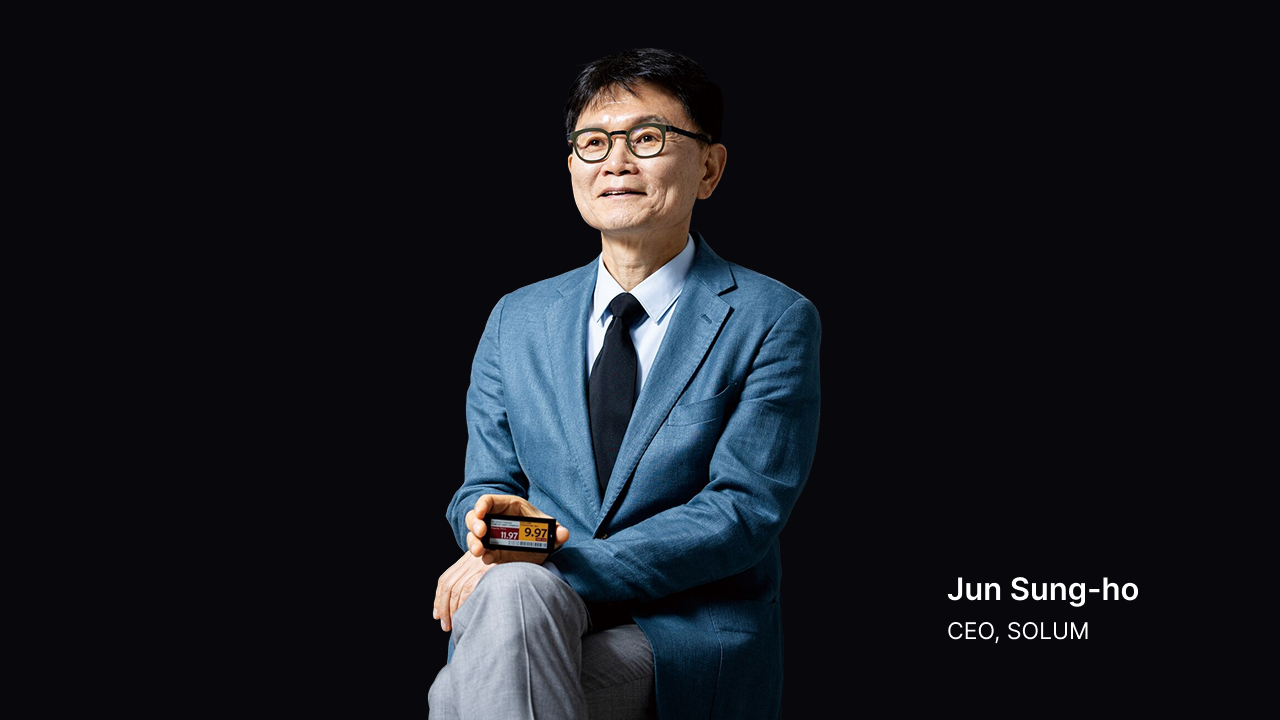
What began as a new challenge for Jun Sung-ho has grown, in just over a decade, into a global business spanning retail technology, K-beauty, EV charging, and power solutions for AI data centers.
💡 AI Summary
- SOLUM’s growth strategy and vision, building on ESL innovation to expand into retail, K-beauty, EV charging, and AI data center power solutions.
Drawing on more than three decades of experience across technology, product strategy, and global business, Jun founded SOLUM in 2015 and saw early potential in Electronic Shelf Labels (ESL) as a way to address a fundamental challenge facing physical retailers: the gap between the speed of online and offline operations.
"Online, prices can be changed in real time with the click of a button. Offline, however, it could take as long as two weeks for a price change to reach stores in regional areas. I believed ESL was a product that could overcome that difference in speed."
Turning that potential into tangible business results took time. The turning point came with the launch of Newton, which improved price update speed, battery life, and durability after the ESL business had remained unprofitable for six and a half years.
"Our competitors entered the market about 20 years before us. Simply replacing paper price tags with ESLs was not enough to compete. We focused on what retailers needed most, particularly the ability to update pricing information for large numbers of products quickly.
"We reduced an update process that used to take 100 minutes to 10 minutes and increased the number of labels that could be updated at once from 10,000 to 100,000. We also extended battery life from five years to ten years and improved durability by adding a protective cover to the display. Newton was the product that brought those three improvements together. Until then, we had been following our competitors. With Newton, we changed the game."
Beyond Price Tags: Becoming an Advertising Platform
With Newton driving its expansion, SOLUM now supplies ESLs to approximately 200,000 stores across around 50 countries. The role of the ESL business within SOLUM has also changed significantly.
"When SOLUM was spun off, ESL revenue was minimal. This year, however, it has exceeded 30% of our total revenue, and we expect it to reach 50% next year. Ultimately, we expect ESL to account for 50% to 60% of total revenue. In the past, our customers were primarily supermarkets. Today, every offline store is a potential customer."
SOLUM is also looking beyond price tags to the advertising market. Large E-Paper solutions, designed to replace in-store advertising posters and promotional materials, are a key part of this strategy. Operating on batteries without requiring separate power cabling, they can also reduce the burden of installation and maintenance.
With Large E-Paper, SOLUM aims to help physical retailers create new advertising opportunities and expand into the Retail Media Network (RMN) business.
"As e-paper displays have evolved to support color and larger formats, they can now be used as advertising media. Our goal is to enable physical retailers to generate advertising revenue just as online retailers do. We are trying to change the rules of the game by reducing installation costs while creating new revenue opportunities."
"We started with just one subsidiary in Germany, but we have continued expanding our sales network to markets including the United States, the United Kingdom, and France. We are also strengthening our presence in India, the Middle East and Africa, and Southeast Asia. Japan has already become our fourth-largest market by revenue just three years after we entered the country."
Expanding into K-Beauty Alongside Retail Customers
SOLUM diversified its business by acquiring GDK Cosmetics. Cosmetics may appear far removed from SOLUM's traditional electronic components business, but Jun saw an opportunity through the company's existing customer base.
"People may wonder why an electronics company would suddenly enter the cosmetics business. But our customers include offline retailers around the world. These retailers are constantly changing what they sell and looking for new product categories to increase profitability.
"Our overseas retail customers also wanted cosmetics, particularly K-beauty products. Since our role is to help our customers generate revenue, I thought we should be able to supply cosmetics as well. That led us to acquire GDK Cosmetics.
"What interested us most was the potential for international growth. Even stores that traditionally sold fruit and vegetables could create a K-beauty section. We could build that section using our ESL solutions while also supplying the cosmetics."
Jun believes SOLUM's global retail network can open new opportunities for K-beauty companies seeking to expand their overseas distribution channels.
"There are a great many K-beauty brands and cosmetics manufacturers in Korea. But with the exception of larger companies, they share a common weakness: limited overseas sales networks. They can develop excellent products and launch brands in Korea but then struggle to find channels through which to sell them overseas.
"SOLUM has retailers around the world as customers and has built sales networks through those relationships. The idea is to connect the products of cosmetics companies with our sales network and develop overseas markets together."
From TV Components to EV Charging and AI Power
SOLUM is also applying technologies developed through its power business to new markets, including EV chargers and power products for AI data centers.
The technological foundation comes from TV power systems. SOLUM developed its 3-in-1 Board by integrating power supply, video processing, and broadcast reception functions into a single unit. By reducing the complexity of circuit design and production, the product became an important foundation for SOLUM's growth.
"After working in the TV business for 30 years, I understood what manufacturing sites needed. Rather than waiting for customers to tell us what they wanted, we developed products first and proposed them ourselves."
SOLUM is now expanding the application of its power technologies. Building on technologies used in mobile phone chargers and TVs, the company developed power modules for electric vehicle chargers. Jun viewed the temporary slowdown in EV demand as an opportunity to complete product development and strengthen quality.
"We thought about applying the technologies we had accumulated through TV power products to applications requiring much higher output. When we looked at the EV charger market, there were many complaints about failures and quality. If the power module, a core component, fails, the charger itself cannot be used. So we made quality and reliability our top priorities in development.
"When the EV market entered a chasm period, we actually saw it as an opportunity to complete development. It is much harder to enter a market once it has already taken off. During the market slowdown over the past two to three years, we completed the development of 30kW, 40kW, and 50kW power modules."
SOLUM has also established overseas references. The company was selected as a supplier to Portuguese EV charging solutions company i-charging and has begun shipping 50kW modules capable of supporting 1.6MW ultra-fast charging systems.
"When working with i-charging in Portugal, we had to adapt to operating environments that were different from those in Korea. Cable lengths and power quality were different, so we had to address electrical noise. To replace equipment already installed in the field, we also had to ensure compatibility with existing firmware and software.
"We solved each issue one by one so that our products could operate not only in new equipment but also in existing installations. i-charging highly valued our responsiveness and ability to resolve issues quickly whenever they arose. Through that process, we built trust and became partners working together to expand in the global market."
SOLUM is developing power products for AI data centers as another pillar of future growth.
"As AI develops rapidly, data centers are becoming larger and customers are demanding products capable of supplying more power within the same physical footprint. In other words, they need products with higher power density. This is an area where we have strengths, so it is creating many opportunities for us."
Building Sustainable, High-Quality Growth
Jun's experience across product development, manufacturing, quality, product strategy, and global business helped shape his approach to growing SOLUM.
"Customers need to feel what makes your product different. You have to offer new value that makes the product they are currently using feel outdated. That is what motivates them to replace it.
One of SOLUM's most difficult periods came in 2017 and 2018 as the company relocated its production base from Dongguan, China, to Vietnam to strengthen cost competitiveness.
"We should have completed preparations so that the Vietnam factory could fully handle the existing production volume before making the move. The strategic direction was right, but the execution was insufficient."
As SOLUM later recovered through products including the 3-in-1 Board and ESL, Jun learned the importance of making investments ahead of demand while having the patience to wait for results.
"If we had not invested in Vietnam, SOLUM as it exists today would not have been possible. We might have survived in Dongguan by generating very small profits, but there would have been no future.
"Upfront investment is essential. But execution must not be rushed. You also need the patience to believe in the potential of a business and continue pursuing it consistently."
That experience has also influenced SOLUM's approach to R&D and talent allocation. According to Jun, SOLUM currently assigns approximately 25% of its workforce to developing new businesses in its search for future growth opportunities, including EV charging and power products for AI data centers.
"A company grows when its established businesses generate stable earnings that allow R&D teams to focus on building businesses for the future. That is something I learned the hard way in 2017 and 2018."
Jun describes his management philosophy as building "a system for sustainable, high-quality growth." At its core is the continued transformation of SOLUM's business portfolio by developing new growth businesses based on the company's existing technologies and competitive strengths.
This philosophy helps explain why SOLUM continued investing in ESL despite years of losses and why the company is now expanding into new areas such as AI data center power solutions and cosmetics.
Jun also emphasized the patience required to wait for new businesses to produce results.
"You might think that if you water something, a sprout will immediately appear, but sometimes weeds come up first. You have to remove the weeds, water it again, and keep waiting.
"And even when the businesses we are preparing today begin to grow, we cannot simply stay there. We must continue investing in the businesses that come next."
Building a Company Employees Can Be Proud Of
Asked what he hopes SOLUM will look like ten years from now, Jun spoke about the pride of its employees and the importance of giving people the opportunity to be part of meaningful change.
"At this point, rather than thinking about what more I personally want to achieve, I want to leave something behind at SOLUM.
"Overcoming something difficult and being able to say, 'I was there, at the center of it,' can be an incredible source of strength.
"Within the next ten years, I hope SOLUM becomes a company where every employee can feel proud to say they work here, and proud of what they themselves have accomplished here."
Source: Forbes Korea
There is no prev News